
VA vs. FHA Loans: When Should a Veteran Choose FHA Instead of VA?
Jun 17, 2026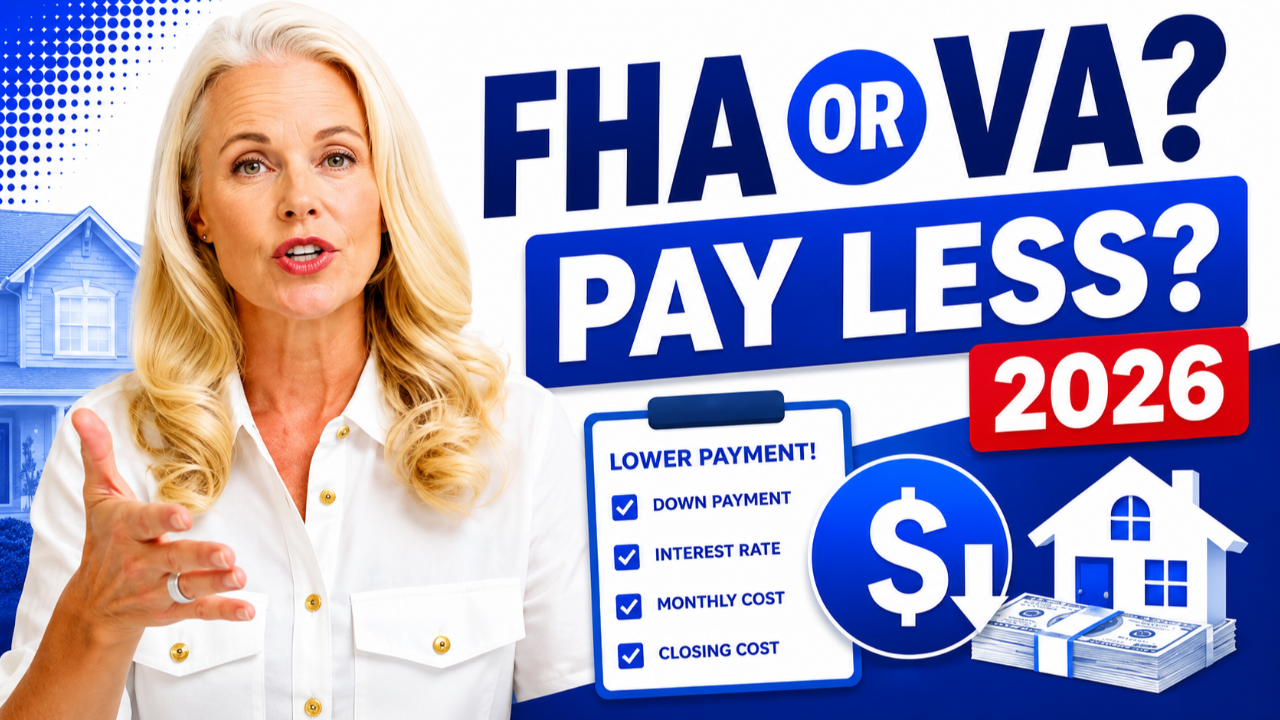
If you're a veteran shopping for a home, you've probably heard that VA loans are one of the best mortgage products available.
And most of the time, that's true.
But there are a few situations where an FHA loan might make more sense.
The problem is that some lenders push veterans into FHA loans for the wrong reasons—sometimes because they don't fully understand VA lending.
If you'd rather watch or listen to the full breakdown, here's the video.
After nearly two decades in the mortgage industry and helping thousands of military families navigate homeownership, I've learned that understanding why a lender recommends a particular loan program is just as important as understanding the loan itself.
The Biggest Difference Between VA and FHA Loans
Let's start with the basics.
VA Loans
VA loans offer several significant advantages:
- No monthly mortgage insurance
- No minimum down payment requirement
- Flexible credit guidelines
- Excellent refinance options
- Residual income calculations designed to help borrowers avoid becoming house poor
For most eligible veterans, VA is typically the better option.
FHA Loans
FHA loans can also be valuable, but they come with tradeoffs:
- Mortgage insurance premiums
- Minimum 3.5% down payment
- Higher monthly payments due to mortgage insurance
- No residual income calculation
Because of those differences, I generally prefer VA whenever a borrower qualifies and the loan structure makes sense.
When FHA Can Actually Make Sense
Despite VA's advantages, there are a few situations where FHA deserves serious consideration.
Scenario #1: Buying a Duplex Without Significant Savings
One of the most common examples involves multi-unit properties.
Let's say you're purchasing a duplex and want to use future rental income from the second unit to help qualify.
With a VA loan, there are additional requirements.
To use projected rental income, borrowers typically need:
- Six months of reserves
- Property management history, or
- A professional property manager
For some buyers, that's difficult to satisfy.
FHA can be more flexible in this situation.
With FHA:
- You can use a portion of future rental income
- Reserve requirements may be less restrictive
- You can potentially qualify with a smaller amount of cash available
The trade-off is a higher monthly payment due to mortgage insurance.
But if the property is a duplex and you don't have substantial reserves, FHA can sometimes provide a path to homeownership that VA cannot.
A Quick Note About Three- and Four-Unit Properties
Many buyers assume FHA works the same way for three- and four-unit properties.
Not necessarily.
Those properties must pass FHA's self-sufficiency test, which evaluates whether the property's rental income can adequately support the financing.
In practice, relatively few three- and four-unit properties meet those requirements.
That's why duplexes tend to be the most common FHA multi-unit success stories.
Scenario #2: Buying With a Non-Military Boyfriend or Girlfriend
This is another situation that surprises many veterans.
Let's say:
- You're eligible for a VA loan
- You're buying with a boyfriend or girlfriend
- You're not married
- Your partner is not military
VA loan rules become more complicated.
If your non-military partner is on the loan, they generally must contribute toward the portion of the financing that isn't covered by VA entitlement.
In many cases, this can result in a substantial required down payment.
For some couples, that down payment requirement becomes a deal-breaker.
FHA doesn't have the same concern.
FHA doesn't care whether borrowers are married.
As long as the borrowers qualify, both parties can be on the loan, subject to FHA's standard down payment requirements.
In situations where both incomes are necessary to qualify, and the couple isn't married, FHA can sometimes be the more practical solution.
Why VA Loans Have Historically Performed Better
One of the most interesting differences between VA and FHA loans is something many borrowers never hear about:
Residual income.
VA loans are the only major mortgage program that uses a residual income calculation.
This calculation goes beyond traditional debt-to-income ratios.
Instead of simply looking at debts and income, VA also evaluates whether a borrower will have enough money left over after paying major obligations to cover basic living expenses.
In simple terms, VA asks:
- Can you still afford food?
- Can you still pay utilities?
- Can you still meet day-to-day living expenses?
It's an extra layer of protection that helps keep borrowers out of financial trouble.
Why FHA Doesn't Have the Same Safeguard
FHA allows relatively high debt-to-income ratios.
However, FHA does not use a residual income calculation.
That means there's no additional check designed to determine whether a borrower will have sufficient leftover income for daily living expenses.
As a result, FHA borrowers can sometimes qualify for larger payments than might be financially comfortable over the long term.
This is one reason many experts believe FHA delinquency rates tend to be higher than VA delinquency rates.
A Warning for Disabled Veterans
This is where things become especially important.
Disabled veterans often receive non-taxable disability income.
Lenders are allowed to "gross up" that income because it isn't taxed.
That can increase the amount of income used for qualification purposes.
With VA loans, however, the residual income calculation still serves as a reality check.
VA ultimately evaluates whether the borrower has enough actual spending power remaining after obligations are paid.
FHA doesn't have that additional safeguard.
Because of this, some lenders may be tempted to move a veteran into FHA when the borrower struggles to meet VA residual income requirements.
That should immediately trigger questions.
If a Lender Suggests FHA, Ask Why
This may be the most important takeaway from this entire discussion.
If you're a veteran and a lender recommends an FHA loan instead of a VA loan, ask questions.
Specifically:
- Why isn't VA being recommended?
- What qualification issue exists?
- What advantage does FHA provide?
- Are there alternatives?
- How much more will the payment be?
- How much mortgage insurance will I pay?
A good lender should be able to explain their recommendation clearly and confidently.
If they can't, that's a problem.
Not Every FHA Recommendation Is Bad
To be clear, FHA isn't a bad loan.
There are legitimate reasons to choose it.
The concern is when FHA becomes the default recommendation simply because:
- The loan officer isn't comfortable with VA
- The lender doesn't fully understand VA guidelines
- Someone is trying to work around a qualification issue that exists for a reason
Veterans earned the VA benefit.
It deserves a thoughtful evaluation before being set aside.
The Bottom Line
For most eligible veterans, VA remains the superior option.
No mortgage insurance.
No minimum down payment.
Excellent refinance opportunities.
Strong borrower protections.
However, FHA can make sense in certain situations, especially:
- Duplex purchases without sufficient reserves
- Home purchases involving an unmarried, non-military co-borrower
The key is understanding why a particular loan program is being recommended.
Never assume the lender automatically chose the best option.
Ask questions.
Understand the reasoning.
And make sure the recommendation truly serves your long-term financial goals.
If you're trying to decide between VA and FHA financing, or if you're wondering whether you're being guided toward the right loan program, my team and I are always happy to help.
📞 Call or Text: 786-933-2077
🏡 Get Pre-Approved: https://www.zerostressmortgage.com
📅 Schedule a Consultation: https://calendly.com/jennifer-beeston